

Blast from the Past
Blast from the Past: forget supercars and hypercars – the Vandenbrink Carver should be the crown jewel of car collectors
F**k you I won’t do what you tell me, sang Rage Against The Machine. Chris van den Brink, the creator of the outlandish Carver One, says it’s his song, his mantra.
An aeronautical engineer by trade, van den Brink was also a keen windsurfer, skier and one of the pioneers of the snowboarding scene, manufacturing his own boards. He and his father would talk about things that bugged them when it came to the world of aerodynamics, and one day they took to task what they perceived to be a fundamental flaw of car design: most cars have only got one person in them – the driver – yet they’re virtually all designed around two people sitting side by side.
Deciding this was a problem that required a solution, the dynamic duo put on their thinking caps and sketched out ideas around motorcycle-based three wheelers with tandem seating. There had been other creations that brought tandem seating to the road – most notably, the Light Car Company’s Rocket, of 1992 (you can read our review of the Rocket here) – but that had a wheel at each corner.
“We had to come up with an invention where the vehicle acts like a motorbike but drives like a car,” recalled van den Brink, in 2020. “It’s easy to develop a very expensive vehicle; it’s very difficult to develop a cost-efficient vehicle.”

Their first prototype was a motorbike with side wheels. It looked a little like an egg laid on its side, and proved tough to crack. It went nowhere.
What came next suggests they’d been smoking some mind-expanding herbal product. Within one month, they made another prototype, this time a rudimentary looking contraption that saw the body and front wheel tilt in turns but the rear engine and wheels remain level. “Right away, it worked perfectly,” says van den Brink.
That Heath Robinson prototype was developed into the Carver, and I still remember to this day – 22 year years later – how hard my jaw hit the floor when I first got to drive it.
At the time I was Deputy Editor of Top Gear magazine, and we’d managed to get our hands on a bright orange Carver for a review, before the telly people – Clarkson, Hammond and May – got their grubby mitts all over it.
Our road test editor, a keen biker, had followed its 11-year development for some time, and managed to have one brought to the office in London’s White City. The office was a depressing, shitty brown low-rise complex that was only good for redevelopment, so the arrival of the Carver brightened everyone’s day.
Out we all went to marvel at this alien contraption. We took turns to sit in it and rock it from side to side with the engine running, and issued all manner of profanities about how odd it felt for the body to lean into corners as you applied steering lock, before forming a less than orderly queue to take it around the block for ‘road test appraisal’ purposes.
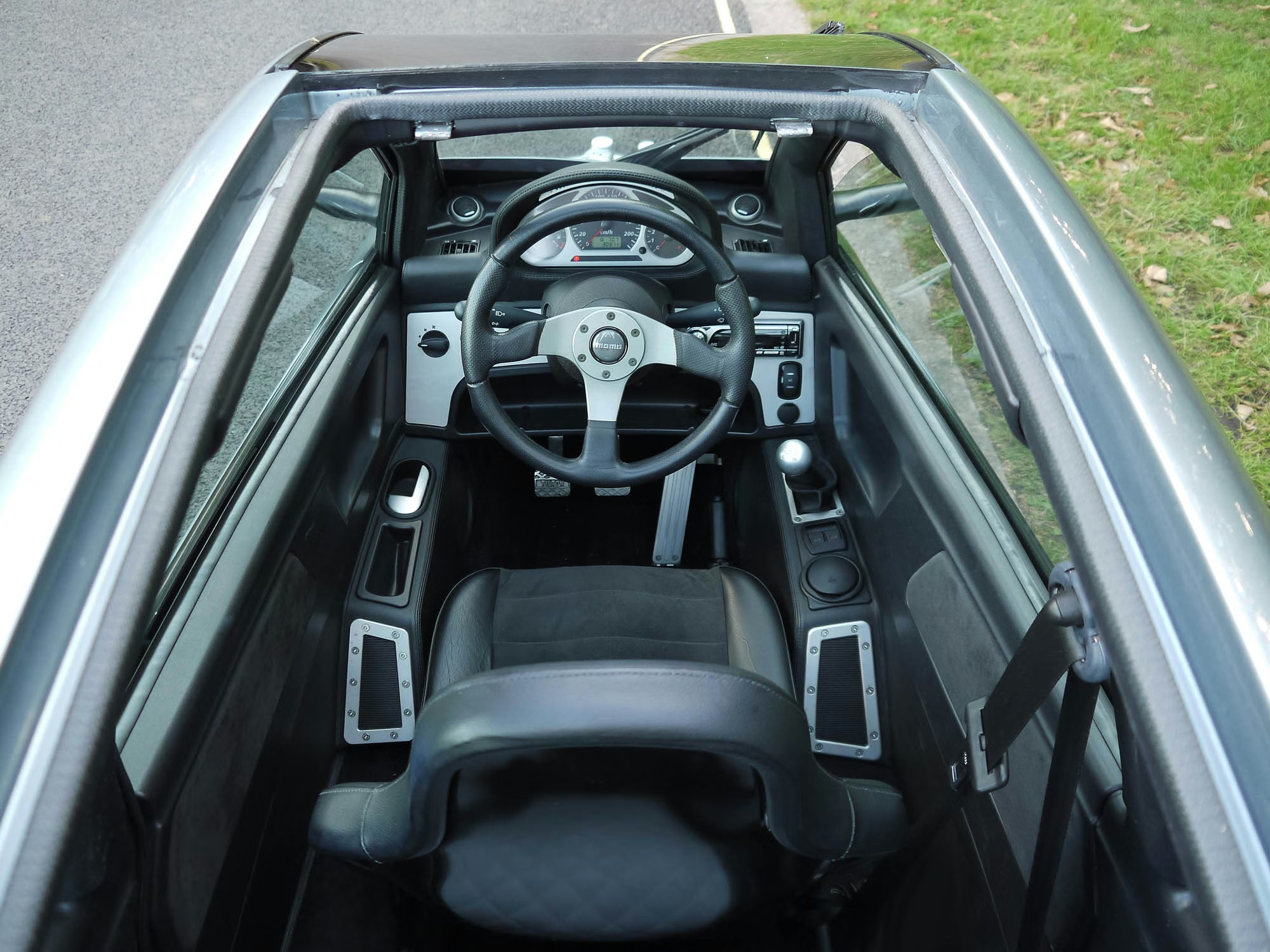
We started with a lap of the office’s car park. At a basic level, it drove like a car rather than a motorbike: there were three pedals, a steering wheel and a gearstick. But what came next was unlike anything any of us had ever experienced…
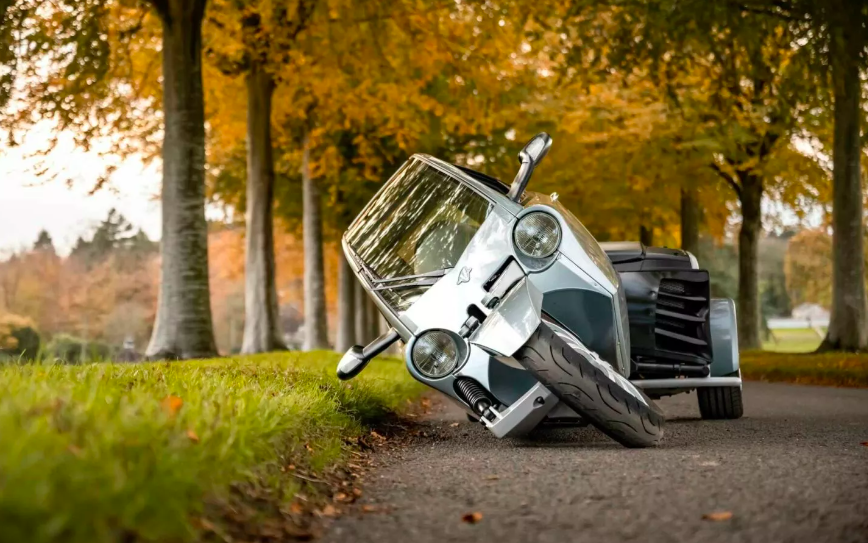
The front 17-inch bike tyre did the steering, but a hydraulic ram at the rear took charge of the theatrics, heaving the cockpit sideways up to 45 degrees. Yet the engine and gearbox – out back between the dual rear wheels – didn’t tilt, instead remaining bolt-upright. Turning aright-hand bend around the corner of the office block, the cockpit felt as though it was going to lean right into the side of the building and smash your face to smithereens. It was at once both terrifying and thrilling. But within a few corners, it became intuitive and you applied a measured steering input that saw the cockpit lean in a predictable fashion.
Power came from a 0.6-litre turbo Daihatsu engine borrowed from a Japanese kei car – small but game – which had a puppyish enthusiasm. It drove through a five-speed manual to a pair of regular 15-inch car tyres, and in standard trim it made 68hp. That may sound laughable but it only had to push 670kg around, which meant it could skip from 0-60mph in around eight seconds. But it didn’t matter one bit how quickly you were travelling, because every change in direction set adrenalin pumping as though you were being fired from a circus cannon.
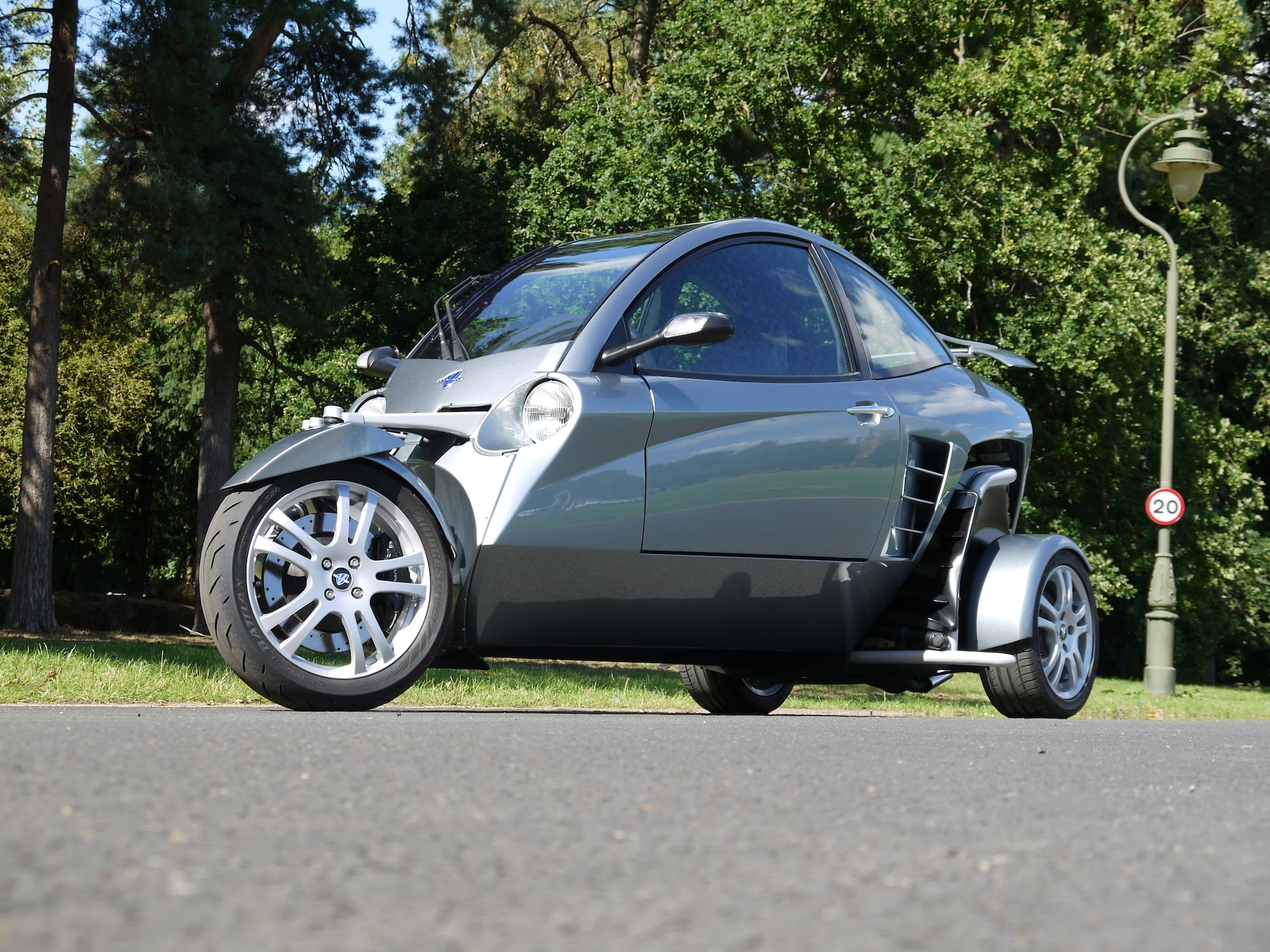
We drove through Shepherd’s Bush, sawing at the steering along Wood Lane for no reason other than to put on a show for everyone around us. Then up we rose, onto the A40, where laps of the Westway Roundabout saw lights glow on the dashboard according to how hard it was leaning over; all three red lights and an accompanying warning beep was the aim of the game.
It wasn’t cheap. The Carver cost £22,500 back in 2003, which would have bought you a Lotus Elise. But once experienced, you knew it was worth every penny. Actually, no, it wasn’t – it was worth a LOT more. In fact, it was almost unquantifiable. There hadn’t been, and has not been since, anything as weird and wonderful as the Carver. How do you put a price on that?
Jeremy Clarkson got to drive the car after us, for the Top Gear telly show, and he was blown away, telling viewers: “I have to say, absolute hand on heart, I’ve never had so much fun in a car. Really and truly. And I don’t think I’d ever tire of it.”
For the car collector who thinks they have everything their heart could possibly desire, the fact is they don’t if they haven’t got a Carver in their collection. You could place it among F40s, F50s, Carrera GTs, Zondas and Veyrons, and still friends would ask if you’d take them out for a spin in the Carver.

View Gallery

Subscribe
Sign up to our newsletter to get all the latest news, events and more from the Racing Green team.
By filling out this form, you agree to the terms laid out in our privacy policy

Redefining collector car storage

By filling out this form, you agree to the terms laid out in our privacy policy


Let's start a conversation...
Please note: Your comments will need to be approved before they are shared with our community. Have fun. Don't be rude or mean. Feel free to criticise ideas, not people. Bad behaviour will not be tolerated.
Lorem ipsum dolor sit amet, consectetur adipiscing elit. Suspendisse varius enim in eros elementum tristique. Duis cursus, mi quis viverra ornare, eros dolor interdum nulla, ut commodo diam libero vitae erat. Aenean faucibus nibh et justo cursus id rutrum lorem imperdiet. Nunc ut sem vitae risus tristique posuere. uis cursus, mi quis viverra ornare, eros dolor interdum nulla, ut commodo diam libero vitae erat. Aenean faucibus nibh et justo cursus id rutrum lorem imperdiet. Nunc ut sem vitae risus tristique posuere.
Delete